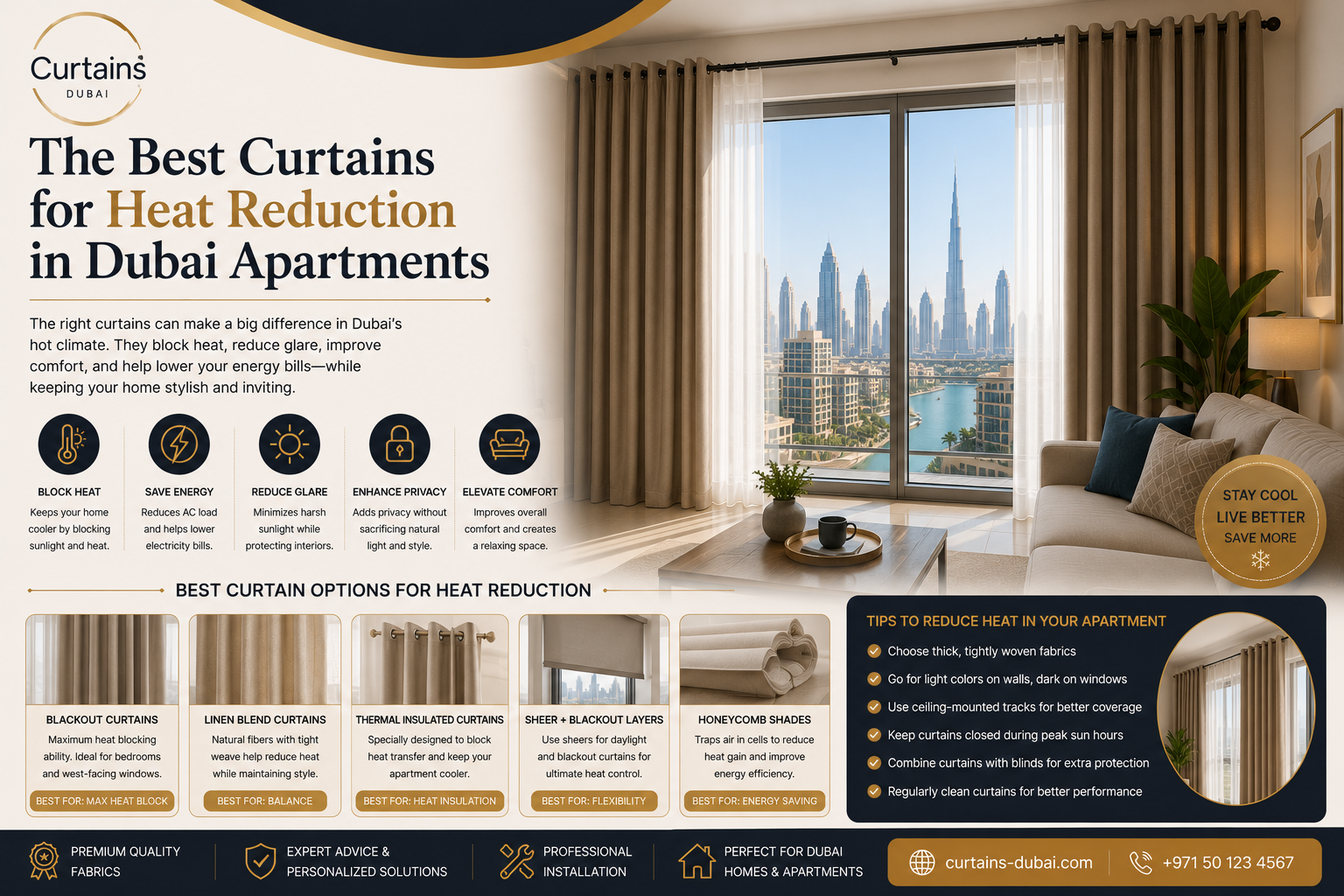
In Dubai’s intense climate, where sunlight and heat dominate most of the year, choosing the right window treatments is essential for maintaining indoor comfort and energy efficiency. Among the most effective solutions, curtains designed for heat reduction play a crucial role in blocking solar radiation, minimizing heat gain, and reducing the workload on air conditioning systems.
The best curtains for heat reduction in Dubai apartments are not just about style—they combine thermal insulation, blackout capability, and high-quality fabric technology to create a cooler, more comfortable living environment.
With modern designs ranging from thermal-lined blackout curtains to reflective and multi-layered fabrics, homeowners can significantly improve both comfort and privacy while protecting interiors from UV damage and excessive heat.
How Solar Reflectance Ratings Help Choose Cooler Curtain Fabrics
Solar reflectance ratings measure how much sunlight a material reflects rather than absorbs, and this directly affects indoor temperature in sun-exposed homes. In Dubai, where solar intensity is consistently high, curtains with higher reflectance values help reduce heat gain by bouncing a portion of incoming radiation back toward the window instead of allowing it to convert into indoor heat.
Lighter-colored and specially treated fabrics typically score higher in reflectance, making them more effective for cooling performance. While homeowners often focus on thickness or opacity, reflectance is just as important because it determines how much energy the fabric absorbs in the first place.
Choosing curtains with high solar reflectance is especially valuable for large glass façades, where even small improvements in heat rejection can noticeably reduce air-conditioning demand and improve comfort.

Why White-Backed Curtains Outperform Dark Linings for Heat Rejection
White-backed curtains are often more effective at reducing heat gain than darker linings because they reflect a greater portion of incoming solar radiation. When sunlight passes through or hits a curtain, the backing layer plays a key role in determining whether that energy is absorbed or reflected.
White surfaces reflect heat outward, reducing the amount transferred into the room, while darker linings tend to absorb heat and slowly re-radiate it indoors. In Dubai’s climate, where windows are exposed to intense and prolonged sunlight, this difference becomes especially important.
White-backed linings also help maintain lower fabric temperatures, which can improve overall durability and reduce thermal stress on both the lining and face fabric. For homeowners prioritizing cooling efficiency, lining color is a surprisingly influential design decision.
The Science of Cellular Curtains vs Traditional Drapes for Insulation
Cellular curtains (or honeycomb blinds) and traditional drapes insulate in fundamentally different ways. Cellular systems trap air within their honeycomb-shaped pockets, creating a barrier that slows heat transfer through convection.
This air-pocket structure acts as a lightweight insulation layer that is highly effective in reducing heat gain. Traditional drapes, on the other hand, rely on fabric mass, density, and layering to slow radiant and conductive heat transfer. Heavier drapes with thermal linings can achieve strong insulation, but they depend more on material thickness than structural air trapping.
In Dubai homes, cellular curtains often perform efficiently in modern minimalist interiors, while lined drapes provide superior full-window coverage and aesthetic flexibility. Both systems improve indoor comfort, but they achieve insulation through different physical principles.
How Curtain Spacing From the Wall Affects Heat Blocking
The distance between curtains and the window surface plays a significant role in thermal performance. When curtains are installed close to the glass, they reduce air circulation and create a more stable insulating barrier, which helps limit heat transfer into the room.
If curtains are mounted too far from the window, warm air can circulate between the glass and fabric, reducing their effectiveness. In hot climates like Dubai, minimizing this gap improves performance because it limits the movement of heated air into the living space.
Properly fitted curtains that sit closer to the window frame can also reduce radiant heat reflection back into the room. This simple installation detail often has as much impact on cooling efficiency as fabric choice itself, making it an important consideration in high-performance window treatment design.
Why Floor-Length Curtains Trap Cool Air Better Than Sill-Length
Floor-length curtains provide better thermal control than sill-length designs because they help contain conditioned air within the room. When curtains extend fully to the floor, they reduce vertical air movement near the window and create a more stable microclimate between the fabric and glass.
This helps prevent cool air produced by air conditioning from escaping too quickly toward the window surface, where it can be lost through heat exchange. Sill-length curtains leave a larger exposed gap that allows more air circulation and reduces insulation effectiveness.
In Dubai homes with high cooling loads, floor-to-ceiling installations are widely preferred not only for aesthetic reasons but also for their contribution to energy efficiency. The added fabric coverage improves both heat rejection and internal temperature stability.
The Best Curtain Materials for West-Facing Dubai Apartments
West-facing apartments in Dubai are exposed to intense afternoon sunlight, which produces high heat loads and strong glare conditions. For these environments, the best curtain materials are typically dense woven fabrics with thermal or blackout linings.
Polyester blends with UV-resistant finishes perform particularly well because they resist fading and maintain structural stability under prolonged sun exposure. Blackout fabrics with reflective white or metallic backings are also effective for reducing heat gain. In some cases, layered systems combining sheer and blackout curtains provide both daylight control and thermal protection.
Lightweight natural fabrics such as untreated linen are generally less suitable unless reinforced with proper linings. Material selection for west-facing windows should prioritize heat resistance, durability, and long-term color stability under extreme solar exposure.
How to Use Curtains and Window Films Together for Maximum Cooling
Combining curtains with window films creates a dual-layer defense against solar heat gain. Window films are applied directly to the glass and work by filtering ultraviolet radiation and reducing infrared heat transmission before it enters the room. Curtains then act as a secondary barrier, blocking residual heat and controlling indoor light levels.
This layered approach is particularly effective in Dubai, where sunlight intensity remains high for most of the year. The film reduces the thermal load on the glass, while the curtain prevents heat from dispersing into the living space.
Together, they improve overall cooling efficiency and reduce strain on air-conditioning systems. This combination also enhances fabric longevity by limiting UV exposure, making it a cost-effective long-term strategy for energy-conscious homeowners.
What Curtain Colors Reflect Most Solar Radiation in UAE
Color has a direct impact on how much solar radiation a curtain absorbs or reflects. Light colors such as white, ivory, beige, and soft greige reflect more sunlight and absorb less heat, making them ideal for hot climates like the UAE.
These shades help maintain cooler indoor temperatures by reducing energy transfer from sunlight into the fabric. Dark colors, such as deep navy, charcoal, or black, absorb more solar energy and can contribute to higher heat buildup unless paired with reflective linings.
In Dubai homes with large sun-facing windows, light-colored curtains are often preferred for their cooling benefits, even when the interior design style varies. Reflective performance becomes especially important in west- and south-facing rooms, where solar exposure is strongest and most sustained throughout the day.
Can Thermal Curtains Reduce AC Running Time in Dubai?
Thermal curtains can contribute to reduced air-conditioning usage by slowing heat transfer through windows, which are typically one of the main sources of heat gain in Dubai homes. By adding insulation through dense fabrics, reflective linings, or multi-layer construction, thermal curtains help stabilize indoor temperatures and reduce the frequency at which AC systems need to cycle on and off.
While they do not replace efficient HVAC systems, they reduce cooling demand by limiting radiant heat entering the room during peak sunlight hours. The effect is most noticeable in rooms with large glass surfaces or west-facing exposure.
Over time, this can lead to improved energy efficiency and lower electricity consumption. The actual impact depends on fabric quality, installation method, and how consistently curtains are used throughout the day.

Frequently Asked Questions
What color curtain reflects the most heat in Dubai?
White or light beige facing the window. Dark colors absorb heat and transfer it into the room.
How can I choose curtains that are suitable for a rental apartment?
renter friendly curtains are a practical choice when you want to improve privacy and light control without making major changes to the property. Consider lightweight fabrics, simple styles, and installation methods that suit the existing setup. Always check your rental agreement before installing curtain hardware, particularly if drilling or permanent fixtures may be required.
Do thermal curtains work differently than blackout curtains?
Yes. Thermal curtains have insulating layers that resist heat transfer. Blackout only blocks light, not necessarily heat.
How can you choose the right curtains for a luxury villa in Dubai?
Choosing villa curtains dubai depends on your villa’s interior style, window size, privacy needs, and preferred level of light control. Consider fabrics, colors, curtain length, and layering to create a balanced look. For large windows, carefully selected curtain designs can enhance the room’s proportions while adding comfort and a refined finishing touch.
How much can curtains lower room temperature in Dubai?
Quality thermal blackout curtains can reduce indoor temperatures by several degrees during peak afternoon sun.
What are the best curtain options for apartments?
The best apartment curtains depend on the room, window size, privacy requirements, and preferred level of light control. Blackout curtains can work well in bedrooms, while lighter fabrics may suit living rooms. For rental apartments, consider easy-to-maintain styles that complement the existing interior without requiring extensive changes to the space.
Should I close curtains on windows that don’t get direct sun?
Yes. Diffuse light and reflected heat still enter through shaded windows. Keeping all curtains closed helps overall cooling.
Can I use curtains on skylights in Dubai villas?
Yes, specially designed skylight curtain tracks exist. Motorization is recommended for hard-to-reach skylights.
Do sheer curtains help with heat reduction at all?
Minimally. Sheers block some solar radiation, but open-weave fabrics allow significant heat transmission.
What’s the best curtain lining for a room with afternoon sun?
Triple-layer: white reflective backing facing window, blackout middle, decorative face fabric on room side.
How tight should curtains seal against the wall for heat blocking?
As tight as possible. Magnetic edge strips or side channel tracks prevent warm air from circulating around curtain edges.
Do curtains work better than reflective window film for heat reduction?
Films are more effective but permanent. Curtains offer flexibility. Use both for maximum protection.