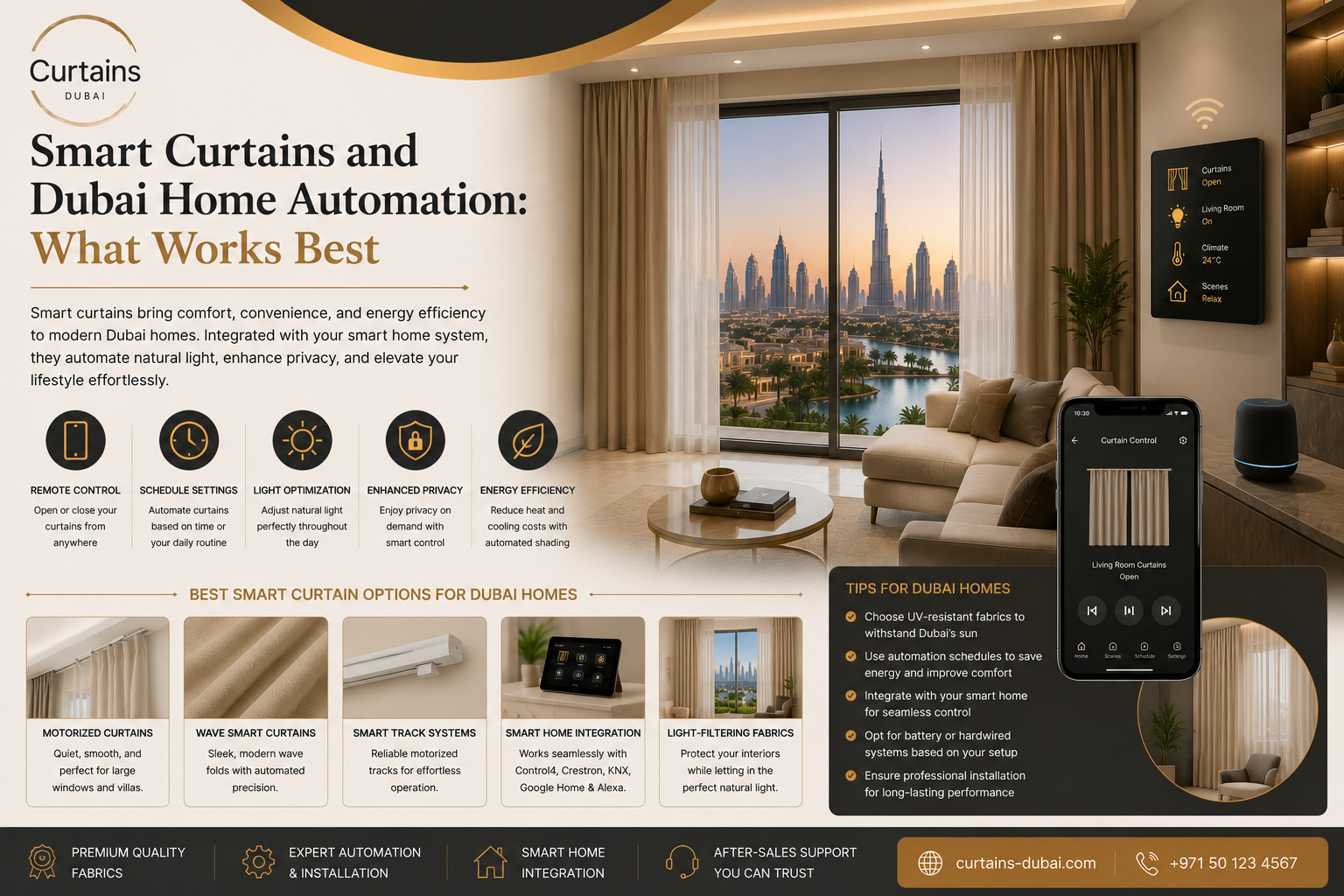
In today’s fast-evolving smart living landscape, Dubai homeowners are increasingly turning to home automation to enhance comfort, energy efficiency, and luxury. Among the most impactful upgrades, smart curtains have emerged as a key feature in modern interiors, seamlessly blending convenience with sophisticated design.
Integrated with advanced home automation systems, these curtains allow users to control natural light, privacy, and indoor temperature with a simple voice command or smartphone tap. As Dubai continues to lead in innovative residential technology, understanding which smart curtain systems work best for local climate conditions, villa designs, and high-rise apartments has become essential. This article explores the most effective smart curtain solutions for Dubai homes and how they are transforming everyday living into a fully connected, intelligent experience.
How to Choose Between WiFi, Zigbee, and Z-Wave Curtain Motors
Choosing between WiFi, Zigbee, and Z-Wave curtain motors comes down to reliability, scalability, and how your smart home is built. WiFi motors connect directly to your router, making them simple to install and ideal for standalone apartments in Dubai, but they can strain networks if too many devices are connected.
Zigbee systems use a dedicated mesh network, which improves stability and allows devices to communicate with each other even if one node fails—this is useful in larger villas or multi-room setups.
Z-Wave is similar but operates on a different frequency and is known for strong reliability and lower interference, though it requires a compatible hub. In Dubai smart homes, Zigbee and Z-Wave are often preferred for integrated systems, while WiFi is common in simpler retrofit installations.

The Best Curtain Motors for Dubai’s Large Window Dimensions
Dubai homes often feature floor-to-ceiling glass walls and wide sliding doors, which require curtain motors with high torque and long-track capability. The best motors for these applications are heavy-duty systems designed to handle large fabric loads without strain or noise.
Key features include reinforced belt drives, adjustable speed control, and support for curved or extended tracks. In villas and penthouses, dual-motor or split-track systems are sometimes used for extra-wide spans to ensure smooth operation.
Noise level is also critical in luxury interiors, so quiet operation motors are preferred for bedrooms and living areas. A properly selected motor ensures smooth movement even with heavy blackout or layered curtain systems, preventing long-term wear and maintaining consistent performance.
Why Battery-Powered Motors Are Ideal for Rental Apartments
Battery-powered curtain motors are especially practical in Dubai rental apartments because they avoid the need for drilling into walls or connecting to fixed electrical wiring. This makes installation reversible, which is important for tenants who need to preserve their security deposit.
These motors are typically rechargeable and can operate for weeks or months on a single charge depending on usage. They are ideal for medium-weight curtains and standard window sizes commonly found in apartments.
While they may not handle extremely heavy or oversized curtains as effectively as hardwired systems, their flexibility and ease of installation make them a popular choice in rental-friendly smart home upgrades. They also allow tenants to enjoy automation without requiring landlord modifications or permanent electrical work.
How to Integrate Curtains With Dubai’s Popular Control4 Systems
Control4 is widely used in Dubai luxury homes as a centralized smart home platform, and integrating curtain motors into it allows full automation alongside lighting, climate, and security systems. Integration typically requires compatible motor controllers or bridges that connect curtain motors to the Control4 ecosystem.
Once connected, curtains can be programmed into scenes such as “Morning,” “Away,” or “Cinema Mode,” where they automatically adjust based on time or activity. In high-end villas and penthouses, this integration is often part of a fully unified home automation experience.
It also allows remote control via mobile apps or wall-mounted interfaces. Proper integration ensures smooth communication between devices and eliminates the need for multiple separate control systems, streamlining daily operation.
The Voice Command Guide for Alexa and Google Home Curtain Control
Voice control for curtains using Alexa or Google Home is becoming increasingly common in Dubai smart homes due to its convenience and hands-free operation. Once curtain motors are linked through a compatible hub or WiFi system, users can assign simple commands such as “open the living room curtains” or “close bedroom curtains.
” These systems can also be grouped into routines, allowing multiple actions with a single command—for example, closing curtains, dimming lights, and adjusting AC simultaneously. Voice control is particularly useful for large floor-to-ceiling curtains that are heavy or difficult to operate manually.
However, reliable WiFi connectivity is essential for consistent performance. Proper naming conventions for rooms and devices also improve recognition accuracy and reduce command errors.
What Happens When Smart Curtains Lose Internet Connection
When smart curtains lose internet connectivity, their behavior depends on the system architecture. WiFi-based curtains may lose remote control and voice assistant functionality but often still operate via physical wall switches or local controls if available.
Zigbee and Z-Wave systems are more resilient because they rely on local hub communication rather than constant internet access, meaning basic operation usually continues even during outages. In Dubai homes, temporary internet loss typically does not stop curtains from functioning, but it may disable scheduling, automation routines, and remote access features.
Once the connection is restored, most systems automatically resynchronize settings. For critical automation setups, having a local control option ensures uninterrupted operation regardless of internet status.
How to Schedule Curtains for Dubai Prayer Times and Sun Position
Scheduling curtains based on prayer times or sun position creates a highly responsive and culturally aligned smart home experience. In Dubai, smart curtain systems can be programmed to open gradually after sunrise or close during peak afternoon heat when sunlight intensity is strongest.
Some systems integrate with location-based prayer time data, allowing curtains to adjust at key daily intervals without manual input. Sun-position tracking is even more precise, as it accounts for seasonal changes in daylight angle and intensity.
This ensures that interior lighting and privacy levels remain consistent throughout the year. Such automation not only enhances comfort but also improves energy efficiency by reducing unnecessary heat gain and optimizing natural light use in living spaces.
Can Smart Curtains Work With Existing Dubai Window Tracks?
Yes, many smart curtain motors are designed to retrofit onto existing curtain tracks, which is particularly useful in Dubai apartments where structural modifications may be restricted. Retrofit systems typically replace or attach to the existing manual gliders, converting them into motorized movement systems without changing the entire rail.
However, compatibility depends on track type, weight capacity, and mounting stability. Some older or decorative rods may require replacement with compatible tracks for smooth operation.
In modern installations, ceiling-mounted aluminum tracks are most commonly adapted for smart motor integration. Proper assessment ensures that the existing structure can handle motor torque and fabric weight without causing strain or misalignment.
The Security Benefit: Simulating Occupancy When You’re Traveling
Smart curtains provide a valuable security advantage by simulating occupancy when homeowners are traveling. By programming curtains to open and close at different times of day, the system creates the impression that someone is actively present in the home.
In Dubai, where many residents travel frequently, this feature adds an additional layer of deterrence against opportunistic intrusion. When combined with lighting and smart home routines, curtain movement becomes part of a broader “lived-in” simulation strategy.
These automated patterns can be randomized or aligned with typical daily routines to appear natural. Even simple scheduled movements—such as morning opening and evening closing—can significantly enhance perceived occupancy and improve overall home security.

Frequently Asked Questions
Do smart curtains work during Dubai power outages?
Battery-powered systems continue working. Hardwired systems require manual override or backup battery modules.
What is a blackout curtain and why is it useful?
A what is blackout curtain is designed to block or significantly reduce light entering a room. It is usually made from dense or layered fabric and can improve privacy while reducing glare. Blackout curtains are commonly used in bedrooms, nurseries, and media rooms where a darker environment and greater control over natural light are preferred.
How do smart curtains integrate with home automation?
smart home automation curtains can connect with compatible smart-home systems to provide convenient control of window coverings. Depending on the chosen setup, curtains may be operated through a remote, smartphone app, or integrated control system. They can be useful for managing natural light and privacy, especially in rooms with large windows or curtains that are difficult to reach manually.
Can I retrofit smart motors to my existing Dubai curtains?
Yes. Retrofit motors attach to existing curtain gliders or bead chains. Measure your current track type before purchase.
What is a blackout curtain and where is it commonly used?
A what is blackout curtain is a curtain made with dense or layered fabric to reduce the amount of light entering a room. It can also support privacy and reduce glare. These curtains are commonly suitable for bedrooms, nurseries, home cinemas, and other spaces where controlling natural light is important.
How do smart home automation curtains work?
smart home automation curtains combine motorized curtain systems with compatible smart-home controls, allowing curtains to be operated without manual adjustment. Depending on the system, users may control opening and closing through a remote, app, or integrated automation setup. They can provide convenient management of natural light and privacy while complementing modern home interiors.
What is a blackout curtain and what are its main benefits?
what is black out curtain refers to a curtain made from dense or layered fabric that helps block or reduce incoming light. It can improve privacy, reduce glare, and create a darker indoor environment. These curtains are often suitable for bedrooms, nurseries, media rooms, and other areas where controlling natural light is important.
What are blackout curtains used for?
If you are wondering what is black out curtain, it is a curtain designed to limit the amount of light entering a room. Its dense or layered fabric can improve privacy and reduce glare, making it useful for bedrooms, nurseries, media rooms, and other spaces where controlled lighting is preferred.
What’s the easiest smart curtain system for Dubai renters?
Battery-powered wand systems that attach to existing curtain rings. No wiring, no drilling, fully removable.
How long do smart curtain batteries last in Dubai?
Quality lithium batteries last months between charges. Daily use reduces battery life. Keep spare charged batteries.
How do smart curtains work with home automation systems?
smart home automation curtains can connect with compatible automation systems to make curtain control more convenient. Depending on the setup, users may operate them through a remote, smartphone app, wall control, or integrated smart-home platform. They can help manage natural light and privacy while reducing the need for manual adjustment, particularly for large or hard-to-reach windows.
What are the advantages of smart curtains for modern homes?
smart home automation curtains offer convenient control of window coverings through compatible technology. Depending on the system, curtains can be operated using a remote, smartphone app, wall control, or integrated home automation platform. This can simplify daily adjustments, especially for large or hard-to-reach windows, while providing greater control over natural light and privacy.
Can smart curtains be controlled when I’m outside Dubai?
Yes, if connected to WiFi. Control via manufacturer app from anywhere with internet access.
Do smart curtains work with Dubai’s 240V electrical system?
Most international brands work with 110-240V. Check specifications. Use certified adapters for local plugs.
How much do smart curtain motors cost in Dubai?
Prices vary by brand and features. Battery motors are affordable; hardwired commercial systems cost more.
Can I install smart curtains on arched or curved windows in Dubai?
Yes, with custom curved tracks and motors designed for curved applications. Not all brands support this.
What smart curtain brand has the best Dubai support?
Look for brands with local distributors and installers. International warranty claims can be difficult without local presence.