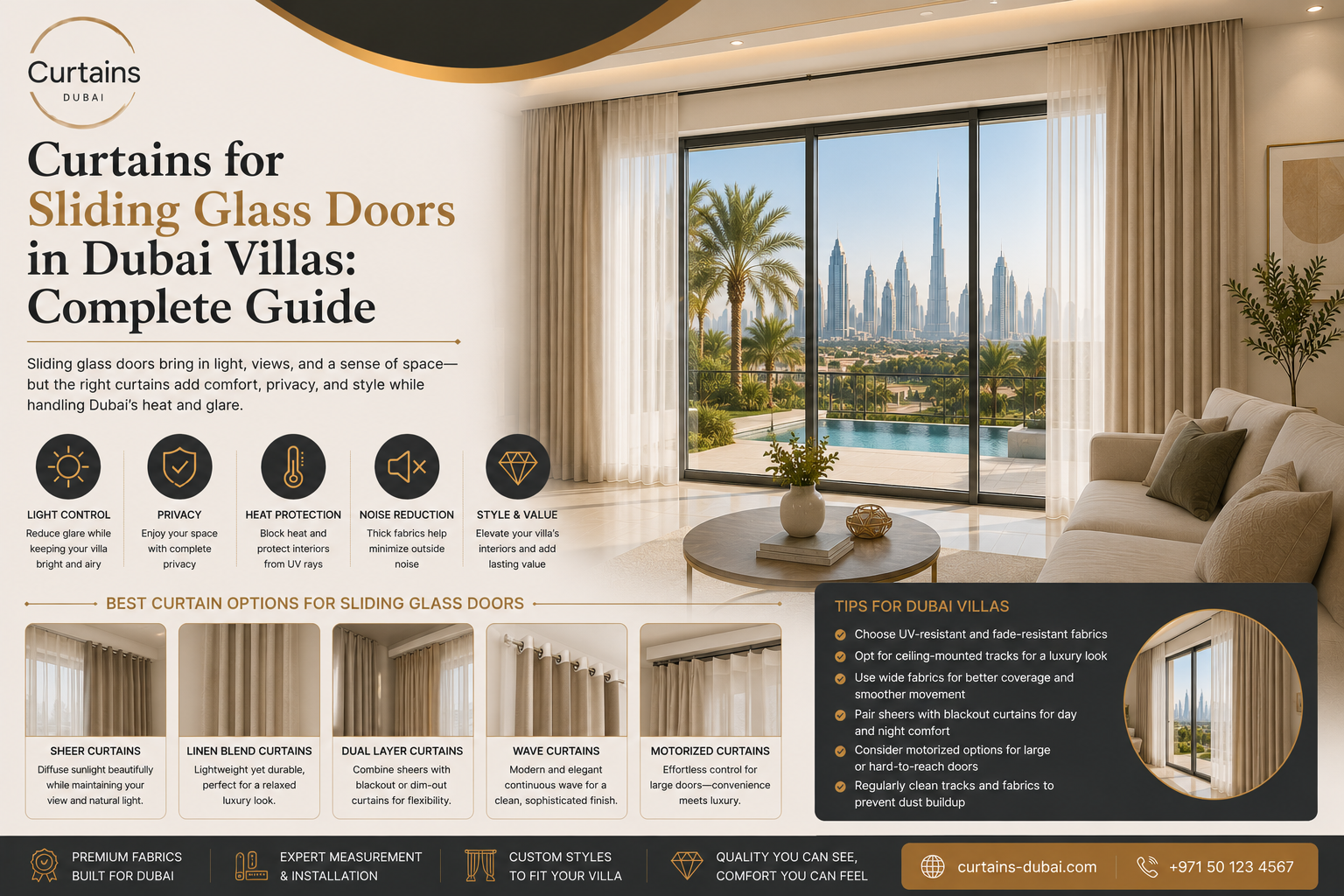
Sliding glass doors are a signature feature of many Dubai villas, bringing in abundant natural light, creating seamless indoor-outdoor connections, and enhancing modern architectural designs. However, choosing the right curtains for these expansive glass surfaces requires careful consideration of factors such as privacy, heat control, energy efficiency, and aesthetics.
Dubai’s intense sunlight and warm climate make curtain selection especially important for maintaining comfortable indoor temperatures while protecting furniture and flooring from UV damage. From elegant floor-to-ceiling drapes to practical blackout curtains and motorized solutions, homeowners have a wide range of options to complement their villa interiors.
This complete guide explores the best curtain styles, fabrics, and installation tips for sliding glass doors in Dubai villas, helping you achieve the perfect balance of functionality, luxury, and visual appeal. Whether you prefer a contemporary minimalist look or a more traditional, sophisticated design, the right curtains can transform your living space while enhancing comfort and privacy throughout the year.
Why Vertical Curtain Tracks Outperform Rods for Wide Patio Doors
Vertical curtain tracks outperform traditional rods mainly because they provide smoother weight distribution and more stable movement across wide spans like patio doors. In Dubai homes, patio openings are often large, floor-to-ceiling, and heavily used, which puts stress on rod-based systems.
Rods tend to sag in the middle under heavy fabrics, especially blackout or lined curtains, leading to uneven operation and visual distortion. Vertical tracks, especially ceiling-mounted systems, distribute weight evenly along the entire length of the rail.
This allows curtains to glide smoothly without friction points or drooping. They also enable tighter stacking at the sides, which is important for maintaining clear access to sliding or hinged doors. Structurally, tracks are simply better suited to long, continuous openings where stability and repeat use are essential.

How to Achieve Full Stack-Back Without Blocking Door Access
Full stack-back refers to how completely curtains gather to the sides when fully opened. In patio door setups, achieving a clean stack-back is essential to avoid blocking access or reducing usable doorway width.
The key is extending the curtain track well beyond the door frame on both sides so fabric can fully clear the opening. Using high-quality gliders and low-friction track systems also helps ensure curtains compress tightly when drawn open. Fabric choice plays a role as well—lighter materials or well-structured weaves stack more compactly than heavy, bulky textiles.
In Dubai homes with wide glass doors, designers often prioritize ceiling-mounted tracks because they allow more precise control over stacking zones. Proper planning ensures the curtains disappear visually when open, preserving both functionality and aesthetics.
The Best Curtain Length for Doors That Open Inward vs Outward
Curtain length should always account for door swing direction to avoid obstruction and fabric damage. For outward-opening doors, floor-length curtains are typically safe because the door moves away from the interior space, minimizing contact with fabric. However, clearance still needs to be considered to prevent curtains from being caught in airflow or door movement.
For inward-opening doors, extra caution is required. Curtains should either be set further away from the door path or designed with split panels that open away from the swing zone. In some cases, slightly raised hem clearance may be used to prevent dragging or interference. In Dubai homes where patio access is frequent, proper coordination between door mechanics and curtain length is essential for both usability and long-term durability.
Why Weighted Bottom Hems Prevent Curtains From Blowing Indoors
Weighted bottom hems are used to stabilize curtain movement, especially in environments with strong air conditioning airflow like Dubai apartments. When AC vents or natural drafts interact with lightweight fabric, curtains can lift, sway, or billow inward.
This not only looks untidy but can also reduce privacy and light control. Adding weights to the bottom hem increases downward force, helping the fabric hang straight and maintain its intended shape.
This is particularly important for floor-to-ceiling curtains, where even slight movement becomes visually amplified. Weighted hems also improve how curtains close, ensuring full coverage without gaps forming at the base. The result is a more controlled, architectural appearance that remains stable even in high-airflow interiors.
How to Create a Single Curtain Wall Covering Doors and Adjacent Windows
Creating a single curtain wall across doors and adjacent windows requires a continuous track system that spans the entire opening without interruption. This approach is commonly used in modern Dubai interiors where large glass facades unify living spaces. The key is ensuring the track is properly aligned and structurally supported across its full length, especially if it spans multiple window segments.
Curtains should be designed as either a single continuous panel system or multiple synchronized panels that meet seamlessly when closed. This creates a visually uninterrupted surface that enhances the sense of space and luxury. Proper measurement is critical to ensure that doors remain fully functional while the curtain system provides complete coverage when needed.
The Child Safety Solution for Sliding Door Curtains With Long Drops
Sliding door curtains with long drops present specific child safety considerations because of their extended fabric length and potential for entanglement. The safest solutions eliminate or control any loose cords and focus on cordless or motorized systems.
Ceiling-mounted tracks with side-draw operation reduce the need for physical handling, minimizing interaction points for children. Weighted hems help keep fabric stable, preventing it from becoming a play hazard due to excessive movement.
In some cases, tie-back systems or concealed side recesses are used so curtains remain securely parked when not in use. In Dubai family homes, especially those with open-plan layouts and patio access, combining motorization with safe track design offers the highest level of safety while maintaining full functionality.
How Motorized Curtains Simplify Daily Operation of Heavy Door Curtains
Motorized curtain systems significantly improve usability for heavy or oversized door curtains by removing the need for manual force. In large Dubai homes, patio door curtains are often made from dense, lined, or blackout fabrics that can be difficult to operate repeatedly throughout the day.
Motorization allows smooth opening and closing at the push of a button or via smart home integration. This is particularly useful for high-traffic doors, where frequent operation would otherwise cause wear on manual systems.
Motorized tracks also ensure consistent movement, preventing uneven pulling or fabric misalignment. Over time, this reduces strain on both the curtain fabric and the mounting system, extending overall lifespan while improving daily convenience.
What Fabrics Resist Fading When Door Curtains Are Frequently Opened
Door curtains that are frequently opened and exposed to sunlight require fabrics with high UV resistance and stable dye structures. Solution-dyed polyester is one of the most durable options because the color is embedded within the fiber rather than applied only to the surface, making it far more resistant to fading.
Heavier woven synthetics and blended fabrics with UV-protective finishes also perform well in Dubai’s intense sunlight conditions. Natural fibers like cotton or linen tend to fade faster unless specially treated or lined.
The frequency of movement also matters—curtains that are constantly drawn open expose different fabric sections to uneven sunlight, which can lead to patchy fading over time. Choosing consistent, UV-stable materials ensures long-term visual uniformity.
How to Seal Curtains Against Door Gaps to Block Heat and Light
Sealing curtains against door gaps is essential for maximizing thermal and light control, especially in glass-heavy Dubai homes. Small gaps along the sides, top, or bottom can significantly reduce insulation effectiveness by allowing heat and light to leak through. One common solution is extending curtain tracks beyond the door frame so curtains overlap the wall when closed.
Side channels or return brackets can also be used to bring fabric closer to the wall, minimizing light leakage. At the bottom, floor-length or slightly puddled curtains help block drafts and light gaps. In high-performance setups, layered systems combining sheers and blackout curtains further improve sealing. Proper installation design ensures that curtains function as an effective barrier rather than just a decorative feature.

Frequently Asked Questions
Do I need special hardware for curtains on sliding glass doors in Dubai?
Yes, heavy-duty ceiling-mounted tracks or commercial-grade rods. Standard hardware sags under wide-span weight.
What should I consider when choosing curtains for a luxury villa in Dubai?
When choosing villa curtains dubai, consider the room’s style, window size, fabric quality, privacy needs, and level of light control. Blackout fabrics can suit bedrooms, while lighter fabrics may work well in living areas. Professional measuring and installation can also help achieve a neat, balanced finish.
Should curtains for sliding doors puddle on the floor or clear?
Clear the floor by a small gap. Puddling fabric gets trapped in sliding door tracks and collects sand.
Can I use vertical blinds instead of curtains for sliding doors in Dubai?
Yes, but vertical blinds click loudly in AC drafts and chains break frequently. Curtains are quieter and more durable.
How do I prevent curtains from blowing outside when the sliding door is open?
Install magnetic curtain weights or a bottom track system. Holdbacks alone aren’t sufficient for windy Dubai days.
What’s the best curtain fabric for a pool-facing sliding door in Palm Jumeirah?
Solution-dyed acrylic or outdoor-rated polyester. Resists chlorine, salt, and UV degradation from reflected pool water.
How wide should curtains be for a 3-meter sliding door in Dubai?
Minimum double the door width (6 meters total fabric) for proper fullness when closed. Triple width looks more luxurious.
How do I choose curtains for a luxury villa in Dubai?
When selecting villa curtains dubai, consider the villa’s interior style, window dimensions, privacy requirements, and desired light control. Floor-to-ceiling designs can complement spacious rooms, while layered or blackout options provide greater flexibility. Fabric quality, color, texture, and professional installation should also be considered to achieve a cohesive appearance that suits the villa’s overall décor.
Can I install motorized curtains on sliding doors that open daily?
Yes, but choose heavy-duty motors rated for high-cycle use. Standard motors wear out quickly with frequent operation.
How do I clean sliding door curtains that touch the floor?
Regular vacuuming with upholstery attachment. Professional cleaning annually. Avoid dragging fabric across sandy floors.
Do sliding door curtains need special fire ratings in Dubai?
Yes if the door is an emergency exit. Curtains must be flame-retardant and not obstruct egress when closed.